Field Notes / a therapy practice
Everything people usually wait until the first session to ask is already on a card here.
I see adults for weekly therapy in [set your city] and online. The fee, the sliding scale, what happens in the first hour, and the kinds of work I pass on to someone else: all of it is written down below, so you can decide whether to call while nobody is watching you decide.
Openings: [set month] First call: 15 minutes, no charge [set yours] Sliding scale: yes, printed below

02 Who this is for
Two cards, and one of them says no.
Turn either card over for the honest version. Both faces are on this page whether or not the turning works.
Card A / front
People I tend to help
- Adults who function well in public and feel worse in private.
- People whose sleep, appetite, or temper changed and who cannot say when.
- Grief that arrived late, or arrived for something nobody held a service for.
- Work that has stopped feeling like work and started feeling like proof.
- People who have tried therapy once, disliked it, and are willing to try a different room.
Over
What that looks like in an hour
We spend the first weeks getting specific. Not your childhood in general: the Tuesday you could not open your laptop. I write a card after each session, we read it back when the weeks blur together, and we change the plan out loud rather than quietly.
If after six sessions you cannot name one thing that is different, I will say so before you do.
Card B / front
Work I pass to someone else
- Anything needing urgent or overnight care. I work by appointment only.
- Active addiction where medical withdrawal is the first step.
- Court reports, custody assessments, and letters that decide something legal.
- Children and adolescents. [set your own age range]
- Couples work, unless the two of you are already seeing someone together.
Over
What happens when I say no
You get names, not a shrug. I keep a short list of people I have actually spoken to, and I send two or three with a line about why each one fits. If nobody on the list has room, I say that plainly and tell you where else to look.
Being told no on a first call is a better outcome than eight weeks of being politely mismatched.
03 The first session
What the first session is actually like
Five cards, in order, front and back. The front is what happens. The back is what you do not have to do.
Card 1 / front
Getting through the door
The address is [set your address]. There is a buzzer marked [set your buzzer label]. Press it at your appointment time, not before: there is no waiting room, and I would rather you sat somewhere comfortable than on a stair.
I open the door myself. We shake hands or we do not. Coats go on the hook by the window.
Over
What you do not have to do
You do not have to arrive early, bring paperwork, or have decided what the problem is. Turning up on the wrong day happens roughly once a month and costs you nothing.
Card 2 / front
The first ten minutes
I explain two things before you say anything: what I write down, and who could ever read it. Then I ask one question, usually some version of what made this week the week you called.
Most people talk for a while and then apologise. There is nothing to apologise for.
Over
What you do not have to do
You do not have to start at the beginning, tell it in order, or cry. If you would rather I asked questions for the whole hour, say so and I will.
Card 3 / front
The middle of the hour
We get concrete. Names, days, rooms, what was said. I will ask what happened in your body while it was happening, because that is usually where the detail people forget is kept.
There is a clock on the shelf facing you, not me. You can watch it.
Over
What you do not have to do
You do not have to answer everything. "I would rather not go there today" is a full sentence and I will move on without a follow-up.
Card 4 / front
The last five minutes
I stop us with five minutes left, on purpose, so nobody leaves mid-sentence. We agree what we do next: another session, a few sessions to see, or a name to try instead.
Money gets said out loud here, including the scale, so you never have to raise it by email.
Over
What you do not have to do
You do not have to book again in the room. Sleep on it and write to me in the week. Nobody follows up twice.
Card 5 / front
Afterwards
Most people feel flat for an hour and better by evening. Some feel worse for a day. Both are ordinary, and both are worth telling me next time.
I write my card that evening: what we covered, what to pick up. You can ask to read what I hold about you whenever you like.
Over
What you do not have to do
You do not have to practise anything between sessions unless we agreed on it together, and you do not have to report back on how it went.
None of the above is a rule you can break. It is a description, written so that the first hour costs you curiosity instead of nerve.
04 How I work
Three habits, kept for as long as they help.
The long version, with the names of the approaches, lives on the approaches card.
Habit 01
We start from what happened
Events before explanations. What was said, who was in the room, what you did next. Patterns show up on their own once there are enough particulars on the table.
Over
Why
Because a story about yourself can be rehearsed, and a Tuesday cannot. Starting at the particular keeps us from agreeing too early on a theory that flatters nobody.
Habit 02
We keep a written thread
A card after each session: what we covered, what we agreed, what to return to. It is the reason this practice is called Field Notes, and the reason week nine can pick up week three.
Over
Who can read it
You can, on request. Otherwise the notes stay with me, kept as [set your records policy] and held for [set your retention period]. The limits on privacy are on the questions card, written out rather than hinted at.
Habit 03
We stop when you are done
Every eight sessions we take ten minutes to ask whether this is still worth your money and your Tuesday. Ending is a normal answer to that question, not a failure of one.
Over
How ending goes
Usually two or three sessions to close properly, so the last one is not a phone call. You can come back later without starting from the beginning: the cards are still in the drawer.
The approaches card, in full Names of methods, the fee sheet, and the cancellation policy.
05 Fees
The fee, and the scale, both written down
Numbers below are placeholders on a demonstration site. Replace every bracket before this page goes anywhere near a client.
Fee card Sample figures
| What | How long | Fee |
|---|---|---|
| First call | 15 minutes | No charge |
| Weekly session, standard | 50 minutes | [set your full fee] |
| Weekly session, lower band | 50 minutes | [set your lowest fee] |
| Online session | 50 minutes | Same as in the room |
| Cancelled inside 48 hours | n/a | [set your policy] |
Say the word scale anywhere in your first message. That is the whole process. I will not ask for pay slips, I will not ask you to explain your situation, and the fee we agree does not change what happens in the hour.
I keep [set a number] of the lower-band places open at a time. When they are full I say so on this card rather than letting you ask and be turned down.
06 The room
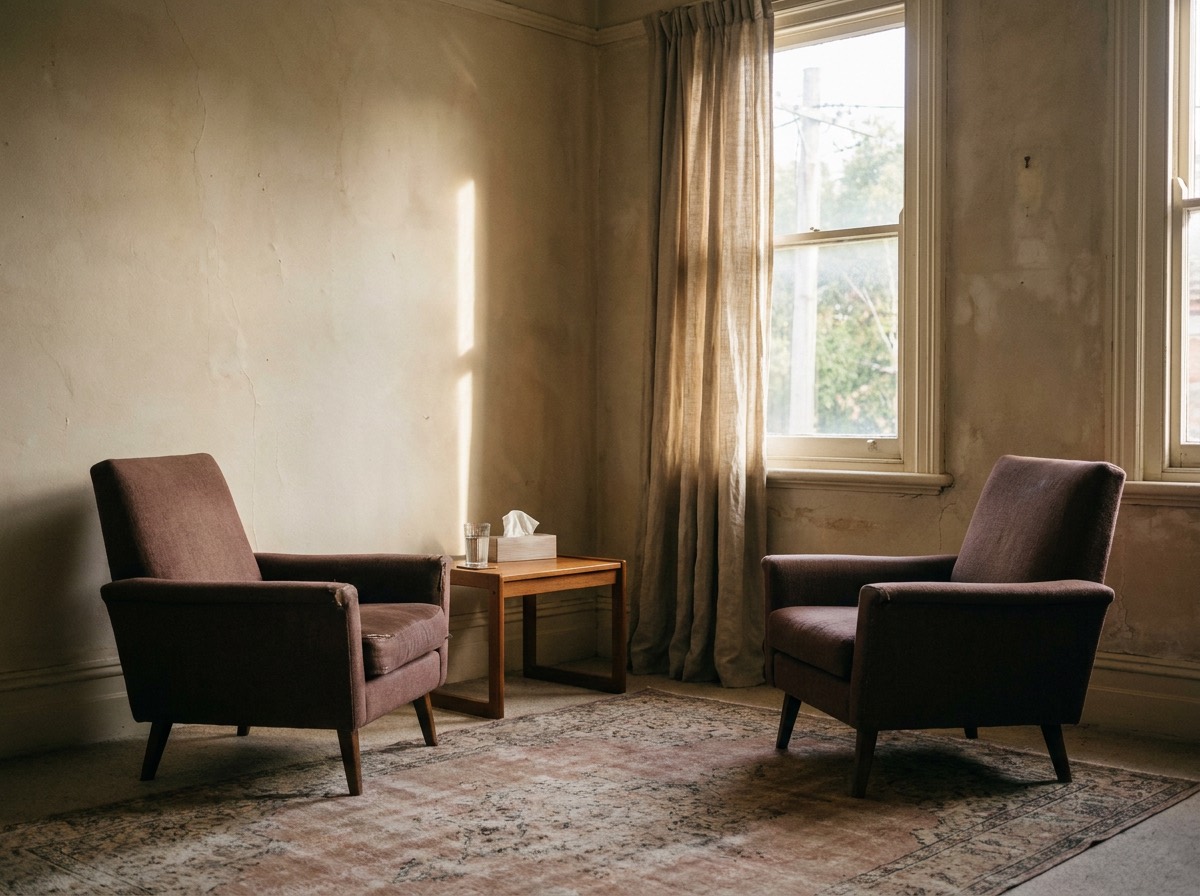
One room, on the [set floor] floor.
It is a quiet building with a stair and [set your lift or step-free access]. If stairs are a problem, tell me in your first message and we will meet online or find a ground-floor room.
Online sessions run on [set your video tool] and work the same way: same length, same fee, same card written afterwards. Some people alternate, and that is fine.
- Sessions run [set your days and hours].
- Street parking on [set your street]; the [set your stop] stop is a few minutes away.
- The room is scent-free, and there is water that is not a performance.
07 Questions
The questions people ask on the phone.
Nobody can tell you honestly at the start. What I can promise is a review every eight sessions where ending is on the table. Some people come for three months, some for two years, and a few come back years later for a handful of sessions.
[set your insurance position]. If you are claiming back, I can give you a receipt with [set what your receipts show] on it. Ask before the first session rather than after, because some plans want a referral first.
Then I ask questions and you answer them, or you sit for a minute and we start with what the silence is like. An empty hour has never once been wasted, and it is not something you can get wrong.
Almost always, and I will tell you the exceptions in the first ten minutes rather than burying them: risk to your life, risk to a child or an adult at risk, and a court order. [set the exact limits required by your licence and jurisdiction.]
I also discuss my work with a supervisor, without your name. That is standard practice and it is how the work stays honest.
Yes, at the same fee and the same length. You need a door that closes and headphones. If your household makes that impossible, say so and we will find a time when the flat is empty.
Say it, at any point, including in minute forty of the first session. I will not take it personally and I will not ask you to justify it. You get names of other people, and if you would rather I did not send anything at all, that is also fine.
08 First call
Fill in the slip. Three lines is plenty.
This goes to one inbox, mine. No newsletter, no follow-up sequence, no third party watching you type.
Direct
hello@fieldnotes.example
[set your number]
I answer within [set your reply window]. If a week passes with nothing, assume the message went missing and send it again: it will not be the first time.
This form is checked between sessions, not constantly. If you are in danger now, or thinking about ending your life, call [set your local emergency number] or [set your local crisis line]. That is the right tool for tonight, and this one can wait until morning.